
Hong Kong engages international planetary scientists with a lunar samples symposium
A volcano of new results which have improved our understanding of our cosmic companion.
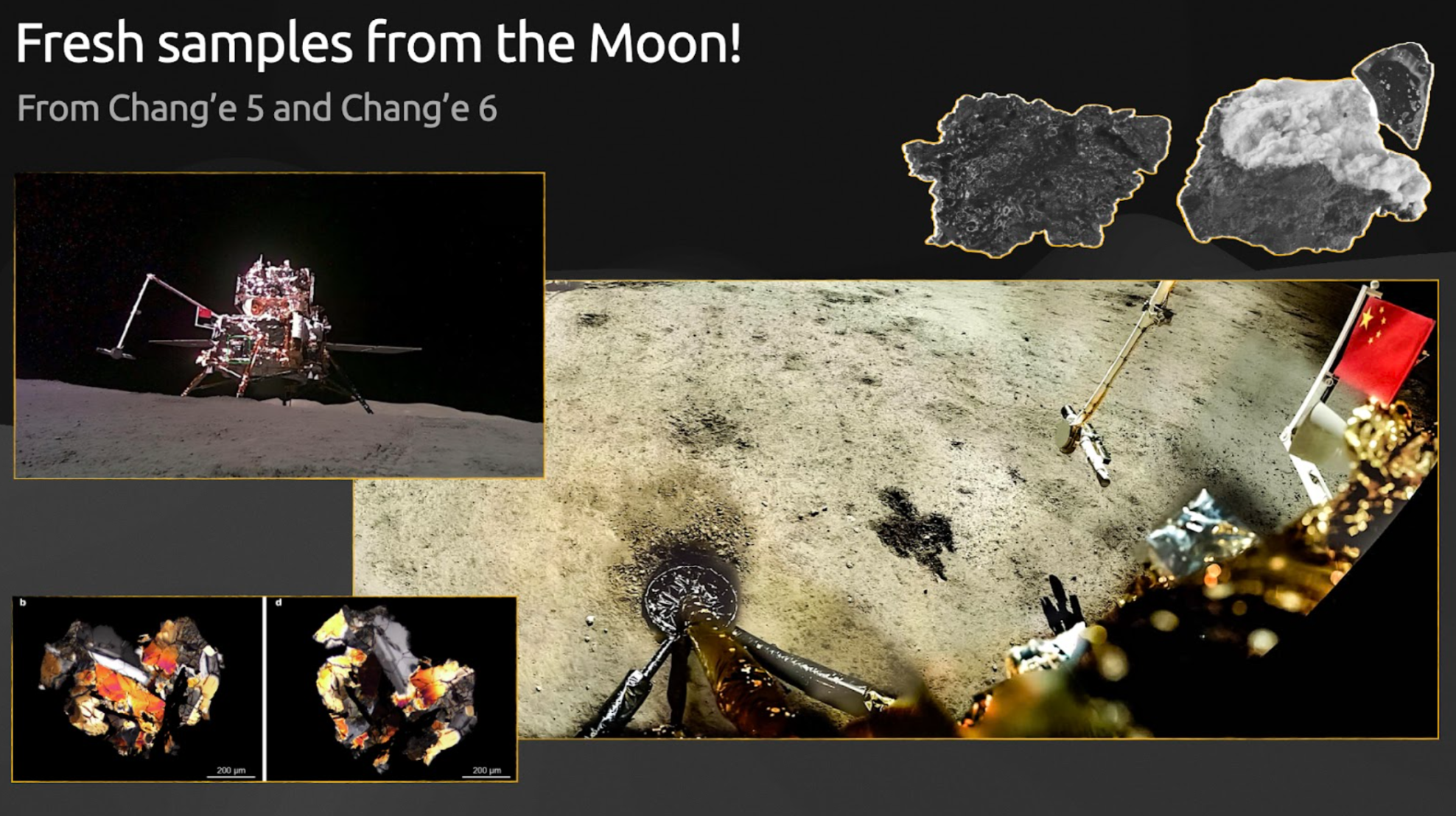
Images: CNSA / CLEP / CAS / Chunlai Li, Shuhui et al. | Graphic: Jatan Mehta
China hosted the International Lunar Sample Research Symposium (ILSRS) at the University of Hong Kong from November 21-23. Our Science Communications Lead, Jatan Mehta, attended the symposium. A major event highlight was the sheer flux of novel lunar science results that researchers presented based on analysis of fresh samples brought from the Moon to Earth by China’s Chang’e 5 and Chang’e 6 missions. Both Chinese and international scientists at the forum discussed how these new results concerning both the Moon’s nearside and farside have helped set the stage for the next set of lunar science observations by missions globally.
The ILSRS conference organizers were the University of Hong Kong (HKU) and the Institute of Geology and Geophysics of the Chinese Academy of Sciences (IGG CAS). They actively reach out to many scientists and people in lunar communities internationally to attend the symposium as the stated intent was to exchange new lunar science findings with the global community and enhance international coordination mechanisms for planetary exploration in China. It’s precisely why the symposium was held in Hong Kong, which allows visa-free access for 170 countries worldwide—whereas hosting in mainland China might have made it difficult for many researchers to attend, especially for those based in the US and India.
Other logistical aspects were also streamlined. The symposium’s abstract submission format was identical to the popular US-based Lunar and Planetary Science Conference, which made it easy for international as well as Chinese researchers to propose their findings to be evaluated for ILSRS talks and posters. These accepted abstracts were reviewed by an international scientific organizing committee for neutrality.
Fuyuan Wu, a leading organizer of ILSRS and a professor at IGG CAS, stressed when he said the following in his opening remarks:
“There is a need for more international collaboration and information exchange in lunar exploration.”
Guochun Zhao, a professor at HKU and a co-organizer of ILSRS, followed up with similar introductory remarks and noted the following:
“No single nation can tackle the complexity of planetary exploration alone.”
The symposium concluded with the organizers explicitly seeking feedback from international attendees, continuing the good show of intent and effort throughout the event. Wei Yang, a professor at IGG CAS and a symposium co-organizer, expressed a forward looking sentiment on behalf of the feedback received from the attendees:
“I hope [that] in the future China and [the] US can exchange Moon samples.”
This was in the context of China’s announcement earlier this year of the first set of international organizations whose proposals were selected to study Chang’e 5 samples. International researchers, including many who attended the symposium, are already analyzing the samples and expect to publish their findings soon whereas US researchers are facing access issues from the American side at the moment.
Read the rundown of new lunar science results: Lunar sample science galore 🌙
